The DST Solution · 1031 Exchange Specialists
Every Problem You Have
as a Landlord Has a Solution.
A Delaware Statutory Trust doesn't just help you sell your property. It solves the tenant headaches, eliminates the repair calls, defers the capital gains tax, and replaces your rental income with something you've probably never had before — truly passive income potential.

— Problem → Solution
How a DST addresses what’s been wearing you down.
Every frustration you’ve lived with as a landlord maps directly to something a DST eliminates. Here’s the side-by side picture.
Landlord Responsibilities
📞. 3am Emergency Calls
You're always on call, no matter what.
😤 Problem Tenants
Late rent, evictions, damage, and disputes.
🔧 Endless Repairs & Maintenance
Unexpected costs that never stop coming.
📈 Rising Operating Costs
Taxes, insurance, and expenses squeezing margins.
⚖️ Legal & Regulatory Risk
Landlord-tenant law, fair housing, local ordinances.
🌍 Geographic Concentration
All your eggs in one local market.
🏦 The Capital Gains Tax Trap
Selling means a potentially massive tax bill.
DST Benefits
😴 Sleep Through the Night
A professional management company handles every call, every repair, every crisis — not you.
🏢 Zero Tenant Interaction
As a DST investor, you have no landlord relationship with tenants whatsoever. That's the trustee's job.
✅ All Maintenance Handled
Operating expenses are managed by the sponsor. You never approve a repair or call a contractor again.
🗺 Instant Diversification
Invest across multiple DST properties in different markets, asset classes, and regions.
📊 Potential for Predictable Distributions
DST income is determined by the offering terms and property performance.
🛡 Liability Shifted to the Trustee
As a beneficial interest holder, you're no longer the landlord. Legal exposure is dramatically reduced.
🔄 Defer Taxes with a 1031 Exchange
Reinvest your full proceeds into a DST and defer capital gains and depreciation recapture — legally.
The 1031 Exchange
Don't give a third of your wealth to the IRS.
When you sell an investment property, the tax bill can feel paralyzing. Federal capital gains tax, depreciation recapture, and state taxes can easily consume 30–40% of your profit. A 1031 exchange into a DST lets you defer all of that — and keep your full equity working for you.
🏠
You Sell Your Rental
Your property closes. Full proceeds are held by a qualified intermediary — not you.
🔄
1031 Exchange
Within 45 days you identify a DST. Within 180 days the exchange closes. Taxes deferred.
🏢
You Own a DST Interest
Full equity reinvested. No tax bill. Professional management. Potential for passive income begins.
Why a DST Works
The features that make DSTs uniquely powerful for landlords.
This isn't just a different kind of investment. It's a fundamentally different relationship with real estate — one that keeps the possible wealth-building benefits and eliminates everything else.
💤 Truly Passive
You are a beneficiary, not a landlord.
In a DST, you hold a beneficial interest in a trust that owns the property. The trustee — a professional real estate sponsor — manages everything: tenants, leases, repairs, vendors, compliance. Your only job is to receive potential distributions.
This is not like hiring a property manager and still being the owner who makes decisions. You are legally removed from the management equation entirely. No approvals, no calls, no decisions.
🏦 Tax Strategy
Keep 100% of your equity working — not the IRS.
Most landlords are sitting on significant capital gains. When they do the math on selling outright, the tax hit is enough to make them stay in a situation they no longer want to be in. A properly structured 1031 exchange into a DST changes that calculation entirely.
You sell, reinvest the full proceeds tax-deferred, and continue building wealth — without handing over a third of it at the closing table. When the DST eventually sells, you can do another 1031 exchange, or your heirs may receive a stepped-up cost basis upon your passing.
🏢 Institutional Quality
Access properties you couldn't own alone.
DSTs typically own large, institutional-grade assets — Class A apartment communities, medical office buildings, industrial distribution centers, and net-lease retail properties anchored by national tenants. These are assets that are professionally underwritten, managed by experienced operators, and often unavailable to individual investors.
Instead of a single-family rental or small multifamily in one zip code, you can invest in a 300-unit apartment complex, diversified across multiple properties and markets.
📊 Income & Tax Benefits
Potential for regular distributions and pass-through depreciation.
Most DSTs seek to distribute income monthly or quarterly, directly to investors. You get the possibility of regular cash flow you were hoping for when you first invested in rental property — without any of the work that came with it.
DST investors also benefit from pass-through depreciation, which can help offset taxable income. You keep the tax advantages of real estate ownership while operating in a fully passive structure.
⚖️ Estate Planning
Pass real estate wealth to your family — without the headaches.
Leaving an active rental property to your heirs might feel like a gift, but it often becomes a burden. They inherit the management responsibilities, the tenant relationships, and the potential for family disagreements over what to do with it.
DST interests can be passed to heirs, and depending on your situation, they may benefit from a stepped-up cost basis at the time of inheritance — potentially eliminating the deferred tax liability altogether. It's a cleaner, smarter way to pass on real estate wealth.
Is This Right for You?
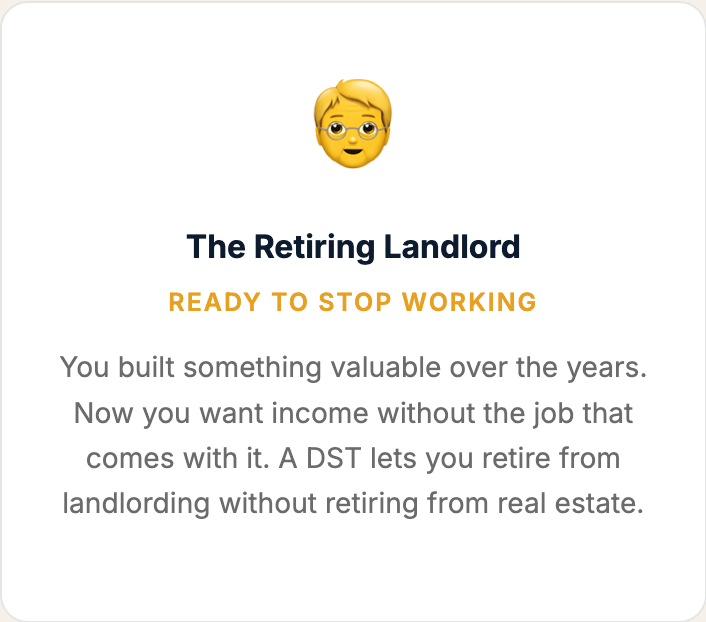
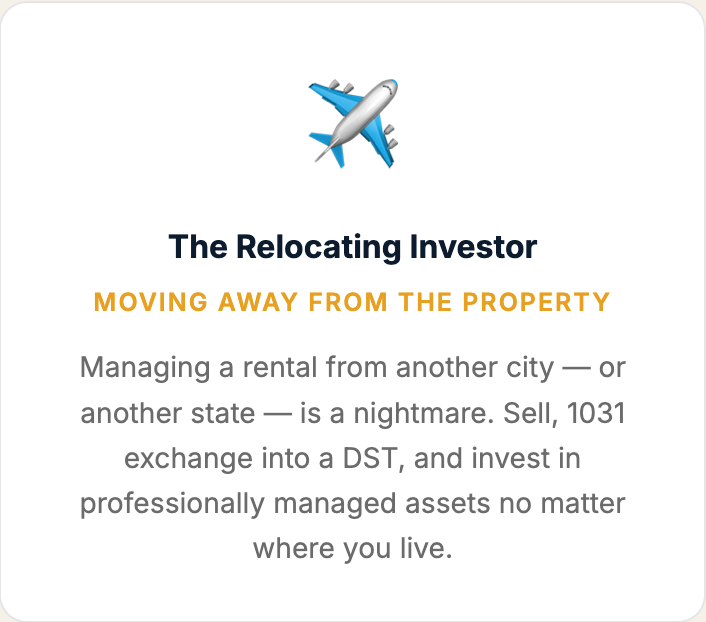
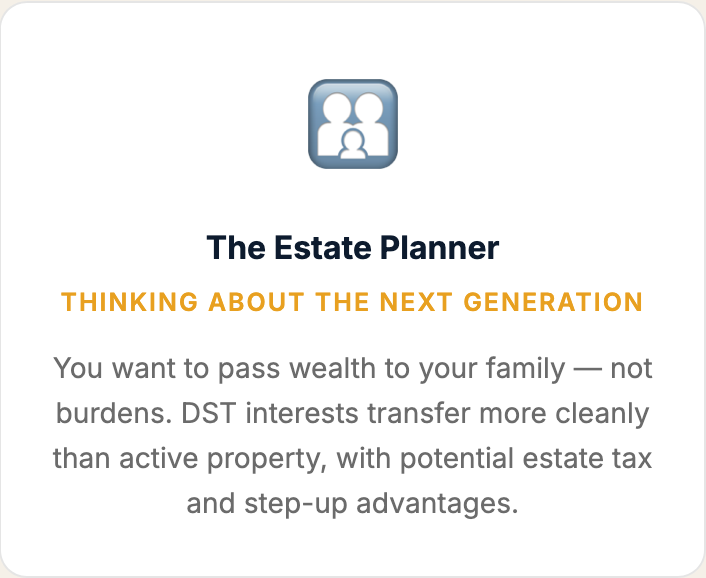
DSTs work especially well for landlords in these situations.
DST investments are available to accredited investors. Beyond that, the situations where they make the most sense are often deeply personal — and very common.



You don't have to keep doing this.
There's a better way to own real estate.
A DST won't fix everything in your life — but it will fix the part where real estate is supposed to be working for you, and instead you're working for it.